MORE to BROWSE - Pages that might be of Interest

Tuesday, 14 January 2020

Tuesday Talk - Walthamstow by Helen Hollick


From 1953-1957, then from 1977-2012, the year of the London Olympics, I lived in Walthamstow, a North-East London suburb. I expect that some of you recall me mentioning it . . .

On January 17th 2013 we (that’s my family) left Walthamstow for the last time and headed for our new home – new life – here in Devon.
I’ve no regrets.

Walthamstow Town Hall (geograph 3019393).jpg
Walthamstow Town Hall,
where I worked for several years
Walthamstow does have its history, its High Street market, its share of famous people and celebs. But it doesn’t have the peace and fresh air of Devon. (Nor the sheep or the owls)

Yep that's a real sheep
walking along the top of
a real Devon Bank
beside a real Devon Lane.
Our lane in fact...
I hated it there – not because Walthamstow was/is a not particularly attractive place but because I hated town life. My soul belongs to the countryside. The one saving grace for Walthamstow was that it bordered Essex and Epping Forest where we kept the horses, where we could walk the dogs and where we could meet Nature up close . We had a nice back garden - but a downstairs maisonette and  unpleasant neighbours.

Our Walthamstow back garden
and Rum -
sadly no longer withus
Walthamstow:

Recorded in c.1075 as Wilcumstowe (The Place of Welcome) and in the Domesday Book of 1086 as Wilcumestou  the Earl of Essex, Harold Godwineson (later  King Harold II of 1066 fame) would have known the town - village. I suspect it wasn’t as crowded back then. (Population 1871:10,692. 1971: 108,845. Definitely no busy North Circular Road or close by ‘London Car Park’  of the M25! Although I expect the River Lee had its fair share of traffic – including more than a few marauding Vikings!

King John visited Shern Hall, Walthamstow in 1213. No idea why. Couldn’t have been for Walthamstow’s famous greyhound racing track – it didn’t exist back then. (Though he might have been in the area for the hunting in what was, then, the Royal Forest of Epping. Henry VIII and Queen Elizabeth I also hunted there.) (Oh and that's were highwayman Dick Turpin lived before his famous ride to York. His ghost apparently still haunts the woods.) 

The main Walthamstow road was (still is) Hoe Street, with Forest Road (called Clay Street back then) and High Street – then known as Marsh Street – for obvious reasons. Walthamstow Marshes still exist and are a recreational area for walkers, fishermen and footballers.  Shernhall Street and Wood Street are still there today.

In 1965 Walthamstow was merged with adjoining Chingford, Leyton and Leytonstone to become the London Borough of Waltham Forest. I remember it well. My Dad had been an independent Town Councillor for Chingford. He was due to serve as Town Mayor in 1965 – but didn’t get the chance because of the merger. He was dreadfully disappointed.

Walthamstow postcode is E17 – some of you may recall there was (for a brief while) a fairly good rock band called E17  . . .  one of them lived down my road!


You Tube video of Walthamstow Market
October 2012
Somewhat noisier than here in Devon

The market that is situated along the length of High Street opened in 1885 and has always been  believed to be one mile long (actually its 2/3 of a mile) but it is the longest street market in Europe, so I guess the inaccuracy is permissible.

Central Library
Of interest to readers, the Central Library is located in High Street, and was built with money given by Andrew Carnegie. Further down High Street there used to be the Junior Library – it was demolished some time in the early 60s and a Sainsburys supermarket stands there now.

This little library has a very special importance to me. I lived in Walthamstow from 1953, when I was born, until 1957 when, at the age of four, we moved to Chingford. I clearly remember coming out of the library very excited because I was clutching a book I hadn’t read. It was one of the Little Grey Rabbit books by Alison Uttley. I fell in love with the series, and thus began my relationship with books. 

We moved to Chingford in the summer when it was hot, to a house at the top of a hill. In the distance at the bottom of the road was one of the reservoirs sparkling blue in the sunshine. The water was low because a good bit of the white-coloured edge could be seen. I was four. I was short-sighted. I could see the water and what I thought was a beach beside it. I burst into tears because Mummy and Daddy wouldn't take me down to paddle in the sea.
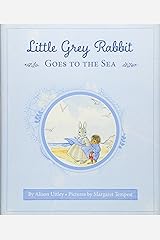
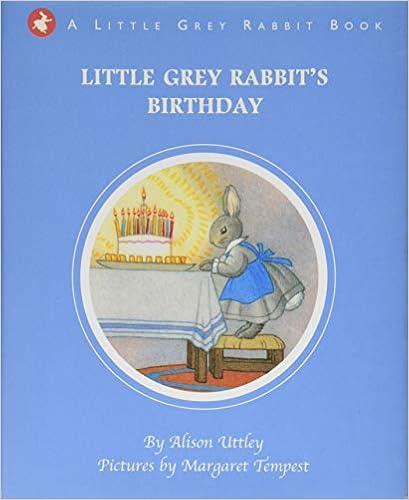
Little Grey Rabbit Goes to Sea Hardcover


Apparently, Walthamstow is mentioned in a song "Old Siam, Sir" from the 1979 album Back to the Egg by Paul McCartney’s band, Wings. Not a lot of people know that. (No, I didn’t either – thank you Wikipedia!)

Remember the group The Barron Knights? "Long ago, outside a chip shop in Walthamstow" is the first line of a song Ann and Joe, The Cranberries had Waiting In Walthamstow, and Genesis (OK you might not have heard of the others but Genesis? Oh come on!) has a track title Battle of Epping Forest on one of their albums.

And the cover of Blur’s Parklife features Walthamstow Dog Stadium. 


Oh, and the Beatles played at the Granada Cinema/Theatre in Hoe Street. I remember that too! Couldn’t hear much singing though.

There are a few famous residents from the past (do I include myself?) 

Remember me mentioning Walthamstow Marshes? You might have heard of one of the, then, young lads who played football there. A certain David Beckham. (He went to the same Chingford school as me, although I was there quite a few years before him!) 

Walthamstow Marshes
Then there's writer, designer, poet, William Morris. Jazz musician Johnny Dankworth, Prime Minister Benjamin Disraeli, Florence Nightingale’s father, singer Ian Drury, Sir George Edwards who designed Concorde,  footballer (Tottenham Hotspurs) Harry Kane, film director Ken Russell... all went to school or college in Walthamstow. (There’s a much longer list on Wikipedia and yes – I AM listed there – “Helen Hollick, writer, born in Walthamstow 1953” )

So all in all, that’s a potted account of Walthamstow.
Like I said, I don’t miss the place.

Call back Friday
for another
Novel Conversation


Friday, 10 January 2020

A Novel Conversation with Annie Whitehead and Archbishop Dunstan

Join Us Every Friday!
#NovConv
To be a little different from the usual 
'meet the author' 
let's meet 
character...


Archbishop Dunstan
from
Q: Hello, I’m Helen, host of Novel Conversations, please do make yourself comfortable. Would you like a drink? Tea, coffee, wine – something stronger? You’ll find a box of chocolates and a bowl of fruit on the table next to you, please do help yourself. I believe you are a character in Annie Whitehead’s novel Alvar the Kingmaker. Would you like to introduce yourself? Are you a lead character or a supporting role?  
A: Good Day, Lady. My name is Dunstan, erstwhile abbot and now archbishop of Canterbury. I do not know of these ‘chocolates’, and I recognise nothing except the apples in your ‘fruit’ bowl, but a cup of wine would be most welcome. You look surprised. Well, we clerics are not abstemious in all things. You would think, wouldn’t you, that my rise from lowly abbot to archbishop would warrant a lead role in this book, but no, I am not even the main enemy of the lead character. I do, however, have the rightful honour of being first to appear in the book, when I find the newly-crowned king romping in bed on his coronation day, with his wife and (shudders) her mother…

Q: What genre is the novel and what is it about?
A: The genre is historical fiction and it is set in tenth-century England. Rest assured it is not all so salacious. It is based on real characters and is the story of Alvar, Earl of Mercia, who became right-hand man to the louche king’s brother and successor. Alvar and I fight constantly, as we each try to advise King Edgar to move along the right path. My task is to restore the monasteries which in my view have become corrupt and amoral. His, to lead the country as its pre-eminent earl, and he has some heart-breaking personal choices to make along the way.

Edgar and Dunstan,
Bath Abbey
Q: No spoilers, but are you a ‘goodie’ or a ‘baddie’? (Or maybe you are both?)
A: I have always sought to serve God. Some might say that sometimes I went the wrong way about it, and closed my eyes to evil deeds when I should have spoken out. I will admit to the sins of pride and envy. A good deal of the latter, actually.

Q:  Tell me about another character in the novel – maybe your best friend … or maybe your arch enemy!
A: My enemy is the ‘hero’ of the story: Alvar. Mercurial, although loyal to a fault. Coarse, energetic, but also, though I hate to say it, a brilliant soldier and counsellor, damn his eyes. The queen fell in love with him and that I couldn’t stomach, she being no more than a Jezebel. (Leans forward). You see, she hated us churchmen for what we did to her, and Alvar swore revenge, but we had to do it, to preserve our reforms. You look like an intelligent lady; you know that naught is more important than God’s work? Means to an end, and all that?
(HH nods understanding)

Q: Is this the only novel you have appeared in, or are there others in a series?
A: My fame is such that others have written about me, but no, this book is what I believe is known as a standalone.

Q: What is one of your least favourite scenes you appear in?
A: Early on in the book, the king banishes me. I did not enjoy being humiliated in front of everyone. But my exile gave me a chance to plot my revenge… I mean, reassess the situation.

Q: And your favourite scene?
A: Any of the scenes where I thwart Alvar? But in truth, the scene where he and I have to work to rescue people trapped in a collapsed building is a favourite, because valuable lessons are learned, and not just by me.

Q: Tell me a little about your author. Has she written any other books?
A: She has written two other novels set in Anglo-Saxon Mercia. The first, To Be A Queen, is the story of Æthelflæd, Lady of the Mercians, daughter of Alfred the Great and the first woman to rule an Anglo-Saxon kingdom. The other is Cometh the Hour, the story of the first, great, king of Mercia: Penda. His kin is mistreated, his kingdom is under threat from without and within, and he’s a pagan in a time when all around him are converting to Christianity. He has to adapt, he has to govern, oh, and he needs to take revenge on the northern kings…
All her novels have won awards. She has also written two nonfiction books. Mercia: The Rise and Fall of a Kingdom was published by Amberley in 2018, and Women of Power in Anglo-Saxon England will be published by Pen & Sword in May 2020.

Q: Is your author working on anything else at the moment?
A: She is working on a collection of short stories and plotting the sequel to Cometh the Hour. She also has plans for a couple of novellas and is beginning to think that sleep is an unnecessary indulgence. Perhaps I should introduce her to the monastic life?

Q: How do you think authors can be helped or supported by readers or groups? What does your author think is the most useful for her personally?
A: Connecting. She likes to stay active on a thing she calls Social Media, because she likes to connect with readers and other authors. Reviews are vital, but so is word of mouth. Readers’ groups can really help with both. And as an avid reader herself, she likes to get lots of recommendations for her own reading!


Thank you, Lord Dunstan, it was a pleasure talking to you. Would your author like to add a short excerpt? Meanwhile, chatting is thirsty work, would you like a refill of that wine…? I’ll have another Gin and Tonic . . .
Salute! Here’s to writing a best seller!

Thank you, Lady Helen, it was a pleasure to grant you an audience. I do not know of ‘gin’, but I’ll gladly have another wine.


CONNECT WITH ANNIE
**And all her novels are 99p/99c until 12th Jan 2020!!**


EXCERPT
[The widowed queen and her ally, Alvar, have been outmanoeuvred by the scheming Churchmen, who think that they have won the battle, if not the war, by crowning their candidate for the disputed kingship. Dunstan, attempting magnanimity, holds out his hand to the furious earl, thinking that he has bested him.]

But Alvar stood back, folded his arms, and stared at him, saying nothing. In the silence that followed, Dunstan withdrew his proffered hand and looked across at Oswald, who shook his head and shrugged.
Still Alvar remained silent and they began to fidget; Dunstan fiddling with his sleeve-ends and Oswald with his fingernails.
    Alvar spoke at last. “Now what?”
    Dunstan struggled to keep his smile from wavering. “M-my lord?”
   “Now what will be done?”
    The archbishop folded his hands in front of his gown. He had seen a challenge where there was none. Alvar’s question was surprising in its simplicity, but he was happy to explain. “N-now you will swear hold-oath to King Edward, and our lives will g-go on much as before.” And then it does not matter if you wed Edgar’s widow. For, having sworn to Edward, you cannot then fight on her son’s behalf. I have won, Earl.
    “No.”
   This time the smile slid away and Dunstan felt his heart hammering. “My lord?”
     Alvar stepped closer, looked him in the eye, and spoke in tones barely above a whisper. “That youth is not born of both a king and a queen, and he is a snivelling shit to boot. I will not swear to him. So I shall tell you what is to be done now. Now you will feel the might of Mercia, and you will learn what a strong and worthy king could stop, that a child-king cannot.”
     He turned round and pulled the door shut behind him, and the only sound was the echo of the door-slam.
     Dunstan stared at the space that Alvar had occupied but a moment before.
   He said, “Archbishop Oswald, I am left with the feeling that we might have overreached ourselves.


< PREVIOUS GUEST     NEXT GUEST >