Monday, 1 July 2019

Tuesday Talk Becalmed Seas and Uncharted Waters


The Doldrums is an area of ocean that, because of the prevailing sullen winds, sailing ships were liable to languish, becalmed, for days on end often with fatal consequences if the drinking water ran out. For an author, a spell of the Doldrums is much the same: languishing with no idea what to write, which rapidly disintegrates into can't be bothered, which then turns to consider giving up altogether.

But is this something that affects Indie writers more than mainstream I wonder? 

I think it is. I've heard from quite a few author friends and acquaintances lately who have said more or less the same thing: "I just can't seem to get the enthusiasm to get on and write, and the necessary  marketing is weighing me down."

For indies, I think this is because we are on our own. No agent or publisher to coax (ok push!) us. No contract deadline looming, no one to encourage or enthuse - unless you're lucky and have a family member to support you - but even then, for indies, an encouraging spouse is not quite the same as the professional publisher or agent. This is because from initial conception to publication - and well beyond - everything is down to us, and, alas, all too often for little reward.

For me, the actual writing is not the problem - I have ideas for stories by the bookshop-load - but the 'giddy-up' to get on with it is often somewhat lacking because there is always that, "oh what's the point?" element nagging (unreasonably) at the back of my mind. 

It does help to know I'm not alone... many indie writers feel the same!


I've been lucky, the Sea Witch series was recently picked up by US publisher Penmore Press - although that has brought its own doldrums and meant sailing into uncharted territory regarding the mammoth task of re-editing and getting the books reformatted and 'out there' in their new 'colours' (to use another nautical term). While exciting, this process is proving to not be easy-peasy plain sailing. So far we only have Sea Witch out as an e-book, although Pirate Code will follow soon. The delay is frustrating, but there is a lot of work to do, (as frustrating as it must have been for those sailors stuck for weeks in the middle of the ocean with no wind to get things moving...)  The delay is because the files for these first books in the series are old (2007) and technology has advanced a lot since then, so the re-formatting fell well and truly into the doldrums - my huge appreciation to Penmore Press for sorting out the muddle, unfortunately, it all took more time than either of us expected... we are sailing onward now though... hopefully under full sail with a following wind...


So what are these Doldrums? Possibly the most famous association is Samuel Taylor Coleridge's poem The Rime of the Ancient Mariner (1798) 

"Water, water, everywhere,
And all the boards did shrink;
Water, water, everywhere,
Nor any drop to drink."
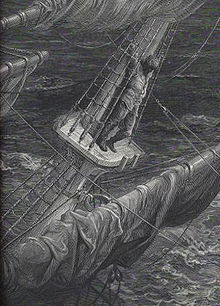
The mariner up on the mast in a storm.
One of the wood-engraved illustrations
by Gustave Doré of the poem.

Wikipedia explains: "The Intertropical Convergence Zone (ITCZ), known by sailors as the doldrums or the calms because of its monotonous, windless weather, is the area where the northeast and southeast trade winds converge. It encircles Earth near the thermal equator, though its specific position varies seasonally. When it lies near the geographic Equator, it is called the near-equatorial trough. Where the ITCZ is drawn into and merges with a monsoonal circulation, it is sometimes referred to as a monsoon trough, a usage more common in Australia and parts of Asia."

Situated slightly north of the equator between the prevailing trade winds, the Doldrums is a notorious region of calm winds, and it is assumed that the common term for feeling low, lethargic or 'down in the dumps' - In The Doldrums - derives from the seventeenth and eighteenth century sailors who experienced this natural phenomenon. 'In the doldrums' was specifically associated with these sailors aboard becalmed sailing ships, but it seems that this assumption is actually the other way around: the area, 'The Doldrums', got its name from the word 'dol' or dull, and 'tantrum' meaning petulance, so The Doldrums were named for one who was dull or lazy - the area was named after the phrase, not the phrase after the area.

This didn't happen until around the mid-1800s when ships' logs noted as being 'In The Doldrums' referred to their location rather than their becalmed state, so the oceanic region became named as 'The Doldrums' by mistake.

There is a reference in The Physical Geography Of The Sea by Matthew Maury (1855), where he states: "The 'equatorial doldrums' is another of these calm places. Besides being a region of calms and baffling winds, it is a region noted for its rains."

Lord Byron used the phrase in 1824 as a nautical context in 'The Island'

"From the bluff head where I watch'd to-day, 
I saw her in the doldrums; 
for the wind Was light and baffling.*" 

*baffling winds = a variable wind that shifts often, making progress for a ship under sail nigh on impossible.

Patrick O'Brian's novel, Desolation Island, one of the Jack Aubrey series, (1978) features the Doldrums - as does the movie Master and Commander (based on O'Brian's books).

So beyond my own doldrum frustration of temporarily being becalmed by the necessity to re-edit the Sea Witch Voyages and the general doldrum feeling by several indie writers, you will not find my Captain Jesamiah Acorne lounging around waiting for a wind In The Doldrums - as his adventures are set in the early 1700s, well before The Doldrums became known as The Doldrums.

Pity, I had an idea for several scenes depicting just that... oh well, back to sitting with my feet up and pretending that thinking counts as working...

buy the book
viewBook.at/SeaWitch


Or how about catching up with Jesamiah's prequel adventure - the story of how he became a pirate?

Buy the book (e-book only)
http://viewbook.at/WhenMermaidSings

Or my non-fiction book about pirates...

buy the book
myBook.to/PIRATESTruthTale


I promise you'll not be becalmed while reading any of them, but absorbed, engrossed, entertained...


Tuesday, 25 June 2019

Tuesday Talk Alison Morton does some Roaming with Romans...and Ruth Downie


Alison Morton talks about 
Ruth Downie's  Medicus series


Alison and Ruth
(outside my house!)
Romans, mud and mystery – a gem of a series!

Much of what Legionary medicus Ruso has been told about Britannia isn’t true. Unfortunately, much of what he’s told by his local expert – the enigmatic and independent-minded Tilla – may not be true either. And when it comes to murder, somebody is lying to both of them. (https://ruthdownie.com)

Written in a self-deprecating tone, the MEDICUS series of books by Ruth Downie are perfect for readers of Roman fiction seeking something more than battles and senatorial conspiracies leading to regime change. Nothing wrong with the latter, but the delight of the almost anti-hero Gaius Petreius  Ruso is that he is a muddler-through: he’s at the beck and call of his superiors, targeted by his emotionally ruthless family to save them financially and taken advantage of by his colleague and friend, the feckless Valens. Desperate to help people, Ruso is realist enough to know he can’t remedy the world’s ills. He’s a Roman, one of the occupiers, the superior class which wields power and control. He takes his duties to his patients seriously, yet under his grumpy exterior his heart is in the right place. Which is a good idea for a doctor.

And Tilla… Ah, Tilla, the stubborn, awkward British slave whom Ruso saves from a beating and death; she drives him to exasperation part of the time and into a state of high anxiety the other half of the time. Somewhere in the middle, though, something much deeper develops.

Ruth - dressed as Tilla
Ruth Downie obviously has a dry sense of the ridiculousness of daily life in any era. Her characters are recognisable in any hospital, office or small business today, as are greed, warm-heartedness and casual cynicism. But intrinsically, they are very much part of their time and this is shown subtly and carefully by the research that has evidently gone into Downie’s books. 

Although readers will subconsciously learn a great deal about Ancient Rome, especially in relation to Britannia, it’s not a heavy lesson. The author goes well past clothes, transport and money deep into the mindset of Romans, Britons, and the multiple nationalities of military, administrators, merchants and scribes scattered through her books. Some readers may be shocked by the pervasiveness of military and political life, by the ruthless drive to take land and willingness to literally put people out on the street. But we are not in the cosseted 21st century. Luckily, Ruso and Tilla somehow manage to weave their way through this labyrinth and the culture clash of their daily lives. Oh, and they solve the odd crime on the way. 

On the practical side, I love the new mosaic style covers for the series and the so familiar Latin phrases used as book titles (I wonder if anybody else has done that… ;-) )

So, let’s start in Britannia where Ruso is a military hospital doctor...


Now called MEDICUS, I first read this when it was called Ruso and the Disappearing Dancing Girls. What a title! 


Britannia - the most remote part of the Roman Empire. Britannia, AD117. Primitive, cold, damp and very muddy.

The Gods are not smiling on Gaius Petreius Ruso in his new posting in Britannia. He has vast debts, a slave girl who is much more trouble than she is worth and an overbearing hospital administrator to deal with . . . not to mention a serial killer stalking the local streets.  

Barmaids’ bodies are being washed up with the tide and no one else seems to care. It’s up to Ruso to investigate, even though the murderer may be hunting him down too.  

If only the locals would just stop killing each other and if only it were possible to find a decent glass of wine and a slave who can cook, Ruso’s prospects would be a whole lot sunnier . . .

But, it’s a series, so we know Ruso survives…


In the hostile north of Britannia Ruso is thrown into a no-win situation. Thessalus, the current doctor at the Fort of Coria, has confessed to a grisly murder but his Prefect demands that Ruso take charge of the patients and convince Thessalus to retract his confession. 

Unfortunately, the corpse is offering up few answers other than to suggest that the natives might be more murderous than restless. If Ruso is to identify the killer, he’ll need all his wits about him to keep Romans, natives and slave girls from each other’s throats.

(Originally published as Ruso and the Demented Doctor)

Now, at last Ruso goes self-employed…


At last, Gaius Petreius Ruso is to return home to Gaul. Little does he realise the sunny Mediterranean lifestyle conceals dark threats. His family are in terrible debt to dangerous men and when the principal creditor, Severus, is poisoned in the Ruso home, they become the primary suspects in his murder. 

But the crimes go far deeper. What role did Severus play in the deliberate sinking of a cargo ship? Who are the brutal investigators sent by Rome? And how worrying is the outbreak of the new religion, Christianity, in the neighbourhood? Even Tilla, his loyal companion, may not be able to save him from the clutches of a most devious killer…

(Originally published as Ruso and the Root of All Evils. )

It’s all about the money…


Ruso and Tilla arrive back in Britannia where his friend and colleague, Valens, has promised to help him find work. While Tilla yearns for somewhere to make a home, Ruso is tasked with hunting down missing tax man Julius Asper. 

Of course, there’s something else missing: money. Compelled to delve deeper when Asper is found murdered, Ruso discovers that the good townsfolk of Verulamium may not be as loyal to Rome as they claim. 

Despite Ruso’s best efforts to get fired from the job of investigator, he and Tilla find themselves trapped at the heart of a treacherous conspiracy involving theft, forgery, buried treasure, and the legacy of Boudica, the rebel queen. 

(Originally published as Ruso and the River of Darkness.)

Ruso just can’t keep away from the Twentieth Legion…


Ruso rejoins his unit in the remote outpost of Britannia, but all is not well with the Twentieth Legion. As the soldiers keep a suspicious eye on the barbarians to the north, they seem to have found trouble even closer to home – among the native recruits in Britannia's imperial army. 

Why did a young legionary jump to his death from the roof of the headquarters building? When more mysterious injuries and deaths begin to pile up in Ruso's medical ledgers, it becomes clear that this suicide is not an isolated incident. Can the men really be under a murderous curse? And what has all of this to do with the much-decorated Centurion Geminus? 

Every Roman soldier seems to end up at Hadrian’s Wall…


Ruso is in the borderlands by Hadrian's Great Wall, but it’s not long since the failure of a blood-soaked native rebellion, and it’s clear to his wife Tilla that the locals are still bitterly resentful. 

When Ruso's new clerk goes missing, tensions mount and rumours begin to spread. Is there really a dead body hidden in the Emperor’s Great Wall? Or is it all a cunning plot by the natives? Things go from bad to worse when the young son of a local family vanishes. 

As Ruso and Tilla struggle to keep the peace between desperate Britons and frustrated Romans, will they unravel the mystery of the two disappearances before it's too late?

Life is short indeed…


Ruso and Tilla leave Britannia for Rome, but their excitement at arriving is soon dulled when they find that the grand facades of polished marble mask an underworld of corrupt landlords, vermin-infested tenements and an over-supply of bad doctors. 

Ruso takes on a reputable medical practice only to find that his predecessor, Doctor Kleitos, has fled, leaving a dead man in a barrel on the doorstep and the warning, "Be careful who you trust." 

Distracted, Ruso makes a grave mistake, causing him to question both his competence and his integrity. With his reputation under threat, he and Tilla must protect their small family from Kleitos's debt collectors, track down the vanished doctor and search for the truth about the unfortunate man in the barrel.

Care for a Bath? Valens is certainly in hot water


A scandal is threatening to engulf the popular spa town of Aquae Sulis (modern-day Bath). The wife of Ruso's best friend, Valens, has been found dead in the sacred hot spring, stabbed through the heart. Fearing the wrath of the goddess and the ruin of the tourist trade, the temple officials are keen to cover up what's happened. But the dead woman's father is demanding justice, and he's accusing Valens of murder.

If Valens turns up to face trial, he will risk execution. If he doesn't, he'll lose his children. Ruso and Tilla do their best to help but it's difficult to get anyone – even Valens himself – to reveal what really happened. Could Ruso's friend really be guilty as charged?


I hope I’ve introduced you to a treasure of new reading. For me, the bad news is that I’ve finished the whole series to date. Ruso isn’t going to fall into the cracks of history, is he? There are taxes to pay, bumbling legionaries to bandage and Tilla to placate. (No pressure on the author…).

Links: 
Ruth’s UK Amazon page:  https://www.amazon.co.uk/l/B001JP8EN0
Website: https://ruthdownie.com
Twitter: @ruthsdownie (https://twitter.com/ruthsdownie)