Monday, 22 October 2018

Tuesday Talk - and Roma Nova Extra by Alison Morton

www.helenhollick.net

So what has Roma Nova, that wonderful series of thrillers set in modern times, based on the idea that Rome had survived, have to do with my interest in the year 1066? Well, one of Ms Morton's stories in her latest book Roma Nova Extra is set in 1066 with the original forming part of the 1066 Turned Upside Down compilation of 'What If' short stories ... (read the others in the collection buy here)


Roma Nova Extra: A collection of short stories from the fourth century to beyond the present for all Alison Morton fans or new readers ... 


Suppose Roma Nova, the last remnant of the old Roman Empire, had struggled through to the 21st century – a tough little country with tough, resourceful people? Apulius, a young tribune sent to a backwater in 370 AD for having the wrong religion, encounters the fiery Julia. What does his lonely descendant, Silvia, labouring in the 1980s to rebuild her country, make of the Italian architect supervising the reconstruction? Can imperial councillor Galla stop the Norman invasion of England in 1066? And will Allegra, her 21st century Praetorian descendant fighting her emotions, find her way to her own happy ending? 

The Girl from the Market AD 370
Lucius Apulius, a young Roman military tribune, is posted to the back end of empire as Rome struggles to keep the barbarians behind the Danube. There, Apulius meets the fiery Julia Bacausa under most unusual circumstances.

Victory Speaks AD 395
In real history, the disappearance of the Altar of Victory is an ancient mystery.
Victory served as the pagan symbol of Rome’s endurance, the guarantor of the empire’s existence. But as the official imperial cult of Christianity swept all before it, Victory’s fate was condemned to historical  obscurity. In the Roma Novan timeline, Victory herself tells us the story of how two senators and a small child step in.

A Roman Intervenes 1066
Galla Mitela, eleventh century imperial councillor, is sent by the imperatrix under pressure from the Eastern Romans of Constantinople to stop William of Normandy invading Saxon England. Could she have succeeded?
(Previously published as part of the 1066 Turned Upside Down collection)

Silvia’s story  1983 (Set just after the end of RETALIO)
Re-building Roma Nova after Caius Tellus’s tyrannical rebellion is pulling on every Roma Novan’s personal strength and resources. Young Imperatrix Silvia devotes herself to her country, but she’s eighteen, exhausted and lonely. Sent by her councillor, Aurelia Mitela, for a few days’ holiday to the spa at Aquae Caesaris, she encounters a young Italian, Andrea Luca.

Games  (Set just after the end of INCEPTIO)
Newly minted Praetorian officer Carina Mitela and her buddy Daniel Stern, a seconded officer from an allied force, love challenges. Dangerous ones. It’s a game to them. But real life gives them a challenge that is anything but a game.

Conrad and Carina’s Roman Holiday  (Set between PERFIDITAS and SUCCESSIO)
Legate Conradus Mitelus, commanding the Praetorian Guard, doesn’t get out in the field very often. Neither does his wife, Carina Mitela, a newly promoted Praetorian major. But a personal quest from the imperatrix sends them on their own ‘Roman holiday’. With a difference.

Saturnalia surprise  (Set after a few years after SUCCESSIO)
When Carina and Conrad’s son Gillius nearly blows himself up just before the Saturnalia winter holiday, he’s sent to Sextilius Gavro, Conrad’s ‘mad inventor’ cousin. Carina is dubious, having met Gavro in New York nearly twenty years before (INCEPTIO), but she is in for several surprises on the first day of Saturnalia.

Allegra and Macrinus  (Set several years after SUCCESSIO)
Highly intelligent, efficient and dedicated to her career in the military, Carina and Conrad’s eldest daughter, Allegra, is losing her grip on her life. Her introverted character prevents her from acknowledging her feelings for a man she has known all her life, let alone doing anything about it. Macrinus has grown up in the Mitela household. His mother was a comrade-in-arms of Aurelia Mitela during the Great Rebellion and tells him Allegra is out of his reach.


Reviews:
"One of the reasons I am enthralled with the Roma Nova series (aside from the skilfully written plots, excellent writing and professional standard of production) is the concept of the whole thing."

"All of them brought different aspects of Roma Novan society from throughout the ages vividly to life, and add further substance to the existing novels, but they'd also work as a stand-alone introduction to the concept of Roma Nova."

"She brings the strict discipline of the Pretorians to life and weaves gripping action into the many field operations and spying sorties,"

"As a disclaimer, I must issue this warning. After reading Roma Nova Extra, you may experience some side effects; such as, the overriding compulsion to reread the Roma Nova series."

The collection is available on Amazon, Kobo, iBooks and Barnes & Noble Nook and in print through your local independent bookshop or favourite online site.

Published by Pulcheria Press
ISBN 9791097310080 (ebook)
ISBN 9791097310103 (print)
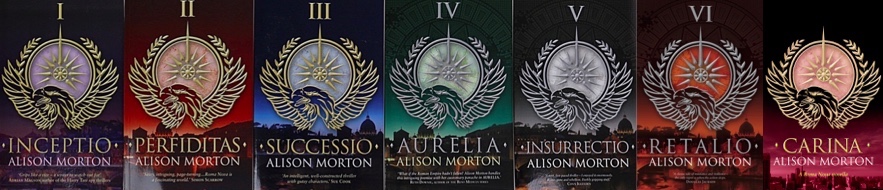
The Roma Nova thriller series
buy from Amazon
Alison Morton is the author of Roma Nova thrillers –  INCEPTIO,  PERFIDITAS,  SUCCESSIO,  AURELIA,  INSURRECTIO  and RETALIO.  CARINA, a novella, is available now.  Audiobooks are available for the first four of the series.


Get INCEPTIO, the series starter, FREE as a thank you gift when you sign up to Alison’s monthly email newsletter. You’ll also be first to know about Roma Nova news and book progress before everybody else, and take part in giveaways.



Thursday, 18 October 2018

Novel Conversations with J.L. Oakley and Jeannie Naughton


 In conjunction with Indie BRAG
posted every Friday
#IndieBragNovConv 

To be a little different from the usual 'meet the author' 
let's meet a character...

Jeannie Naughton
from 


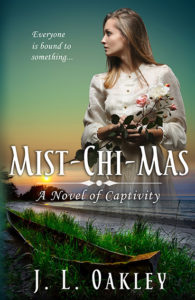
Q: Hello, I’m Helen the host of Novel Conversations, please do make yourself comfortable. Would you like a drink? Tea, coffee, wine – something stronger? You’ll find a box of chocolates and a bowl of fruit on the table next to you, please do help yourself. I believe you are a character in J.L Oakley’s novel Mist-chi-mas: A Novel of Captivity. Would you like to introduce yourself? Are you a lead character or a supporting role? 
A: I am Jeannie Naughton late of Fort Victoria in the Colony of British Columbia and I would like tea very much.  You have chocolate, you say? Such a rarity in these parts and very dear to buy. When I lived in England as a girl, I loved going to Fry and Son’s French Chocolate in London. And yes, I am the lead character.

Q: What genre is the novel and what is it about?
A: Mist-chi-mas: A Novel of Captivity is historical fiction set in the Pacific NW 1860s. It’s a love story too. Forgive me, if I blush.  Comportment, you understand, is very important in my time. Here’s what the story is about:

In Mist-chi-mas, everyone is bound to something.Jeannie Naughton never intended to run away from her troubles, but in 1860, a woman’s reputation is everything. A scandal not of her own making forces her to flee England for an island in the Pacific Northwest, a territory jointly occupied by British and American military forces. At English Camp, Jeannie meets American Jonas Breed. Breed was once a captive and slave — a mistchimas — of the Haida, and still retains close ties to the Coast Salish Indians.
But the inhabitants of the island mistrust Breed for his friendship with the tribes. When one of Breed’s friends is murdered, he is quickly accused of a gruesome retaliation. Jeannie knows he’s innocent, and plans to go away with him, legitimizing their passionate affair with a marriage. But when she receives word that Breed has been killed in a fight, Jeannie’s world falls apart. Although she carries Jonas Breed’s child, she feels she has no choice but to accept a proposal from another man.
Twenty years later, Jeannie finds reason to believe that Breed may still be alive. She must embark on a journey to uncover the truth, unaware that she is stirring up an old and dangerous struggle for power and revenge…

Q: No spoilers, but are you a ‘goody’ or a ‘baddie’? (Or maybe you are both!)
A: I am one and twenty and what you call, a goody. I have tried my very best to  be a good and honest young woman, but life has not always treated me that way. That is why I found myself here in the wilderness of the Pacific Northwest.  I came alone from England with my young son and enjoyed the protection of my Uncle Archie who was a trader at the Hudson’s Bay trading fort in Victoria. But it was when I made a trip to the Royal Marine encampment on San Juan Island to attend a tea given by the wife of the assistant surgeon that I found the place where felt at home for the first time.

Q:  Tell me about another character in the novel – maybe your best friend, lover or partner … or maybe your arch enemy!
A: I would be remiss not to talk about Mr. Breed—my dear Jonas—who opened my eyes beyond the stiff rules of my English society to societies of the Salish Sea: the Songhee, Lummi and other Coast Salish peoples and Kanakas—know them as Hawaiians—who worked at the Hudson Bay farm. Mr. Breed was born in Hawaii and after he went to sea with his father, he was captured by the Haida to the north of Vancouver Island. He was a mistchimas then, but gained his freedom when he saved the life of his master. Back in white society, he worked many trades, spoke native tongues and Chinook Jargon, which he taught me. Mr. Breed scared me at first meet, but I began to regard him highly. He is very handsome, a kind, capable man, but not afraid to stand up for what was right, sometimes with violence.

Q: Is this the only novel you have appeared in, or are there others in a series?
A: For now, it is the only novel I am in, but sometimes I hear stirrings that I may appear in something in the far future, if my author is inclined.

Q: What is one of your least favourite scenes you appear in?
A: Oh, dear, that would be when my little boy took ill. The variola major is such a terrible thing. When the scourge arrived in Victoria in the early 1860s, after felling many in our little town, it was carried home to Haida, Tlingit and Tsimshian communities to the north. Later I learned that it wiped out 80 per cent of those people. I feared for the life of my sweet Jeremy.

Q: And your favourite scene?
A: So many, so many, all with Mr. Breed.  I suppose the one that sticks out the most is the time we danced on the ramparts above the American encampment. At the time, I was not allowed to dance or show delight in things. At a joint party with both Royal Marine and American officers attending along with local guests from Victoria and Washington Territory, I had to sit and fill up my dance card with only conversation. Secretly we left and went up to the ramparts and danced to the music coming up from the parade ground. At first, he just wanted to find out what was upsetting me, but after showing the beautiful view under moonlight, he guessed my heart, that I wanted to dance. He told me he knew how and would not step on my feet. I knew then that I was falling in love in him. When he put his hand on my waist...

Q: Tell me a little about your author. Has she written any other books?

 J.L. Oakley

A:  My author lives in the Pacific NW. She writes award-winning historical novels and mystery novellas in Hawaii with a touch of history in them. Outside of the stories in Hawaii, most of the novels are set in the Pacific NW. A single one takes place in Norway during WWII. When she is not writing, she enjoys weaving, gardening and doing local historical projects.

Q: Is your author working on anything else at the moment?
A: My author is working hard on the sequel to her award-winning novel, The Jøssing Affair, set in Norway during WWII. Last fall, she made a trip to Norway to do research. Presently, she has around 60,000 words. In addition, my author is preparing for presentations at several conferences this fall, one at Pacific Northwest Writers and another, a gathering of Civilian Conservation Corps historians and alumni in Portland, Oregon. The CCC built our beautiful parks across the US and in Hawaii and Alaska during the Great Depression.

Q: How do you think indie authors, such as your author, can be helped or supported by readers or groups? What does your author think is the most useful for him/her personally?
A: Write a review, most importantly on Amazon. My author would appreciate that. Then share the book with your book club, reminding your members that authors would love to chat via Skpe or Google chat during the discussion.  Ask your local library to carry the novel. Put the book in a tiny library if your town or neighbourhood supports the program.

Q: Finally, before we must bid adieu, the novel you appear in has been awarded a prestigious IndieBRAG Medallion, does your author find this helpful, and is there anything else he/she would like IndieBRAG to do to help indie authors receive the recognition they deserve?
A: The beautiful IndieBRAG Medallion stands out on the cover of Mist-chi-mas. Readers see it immediately on the shelf at my author’s indie bookstore, but they also see it means something, that the novel is worth buying and reading. My author is very grateful and honoured to have it. It’s important to always to grow as a writer and aim for this seal of approval. This conversation is a fun addition to writers with the medallion. (Thank you very much for interviewing me). The medallion is also helpful in getting a spot on Bargain Booksy and Free Booksy. Novel. I’m looking forward to IndieBRAG’s forays into conferences.

Helen: Thank you Jeannie, it was a pleasure talking to you. Would your author like to add a short excerpt? Meanwhile, chatting is thirsty work, so would you like more to drink?
Jeannie: More tea, please and did I see some little ginger cookies? My favorite.
Helen: Indeed you did - I'd forgotten about them! Cheers! Here’s to being a successful Brag Medallion Honouree!

Excerpt from Mist-chi-mas
There! Something grunted, the voice edged in pain. Her horse began to tremble and put its ears back. Jeannie looked behind her, but saw nothing. She tapped the horse with her riding crop and went forward. The trees thinned out. She could see the stony beach below where someone had pulled a small dugout canoe up on the shore. Water lapped at the canoe’s stern.
   Jeannie was so focused on the canoe that she missed the crashing black shape of a boar charging through the woods, its red mouth open with curled yellow tusks aimed at her horse’s legs. By the time she heard its shrill squeal, it had hammered into her horse, knocking her off her perch. The horse neighed and reared, tearing her last hold on the reins away. A final buck and she was falling down the ledge, rolling over and over again. She screamed as she frantically tried to grab onto anything to stop her tumble, but it was over fast as she started when she landed hard on the ground. Dazed for the moment, she finally staggered to her feet. Her sleeves were torn, her skirt ripped so that she could see her mud-stained petticoats. Her hair fell out of its pins.
   Gasping, Jeannie limped away toward the safety of the canoe. Above her the horse and the boar continued to thrash around. Suddenly, the low ridge exploded with broken branches and pebbles and the roan fell down just feet from where she had been standing. Close behind came the biggest black boar Jeannie had ever seen. As the horse and boar untangled, she saw for the first time that the horse was hurt badly. The skin on its cheek was torn, leaving patches of bloody flesh beneath; its legs were bleeding from gashes. Both horse and boar squealed with hurt and anger as they righted themselves.
   A peculiar feeling of lightness came over her. The pit of her stomach became cold. She could barely think, but she knew she was in extreme danger. Shaking, she backed up against the canoe and pushed it out into the water, ignoring the chilly water of the channel soaking her boots and skirt. When it was afloat, she turned in time to see the horse separate from the boar and buck its way down the beach.
   “Go, go,” Jeannie shouted as she pushed the canoe back further, then realized that only the horse was making its escape. The boar was now trotting back, its little eyes trained on her.
   There is blood all over its face and tusks, she thought. She hopped and scrambled into the canoe, her skirt catching at the gunwales. The boar charged.

INDIE BRAG LINKS:
Twitter: @IndieBrag

HELEN HOLLICK:
Subscribe to newsletter:  http://tinyletter.com/HelenHollick
Twitter: @HelenHollick


< PREVIOUS GUEST     NEXT GUEST >  


full guest list: click here